
DFW local SEO services and paid advertising strategies represent two distinct paths to online visibility, but choosing the right approach can make or break a small business in North Texas. This goes beyond having a great business in Dallas–Fort Worth. Your services are good, and you know there are people looking for what you offer. But how do you get those people to find you online without spending more on marketing than your business can comfortably afford? This is a question many small business owners in Dallas, Fort Worth, Arlington, Plano, Irving, Frisco, and surrounding communities face.
Some business owners invest in Google Ads because they want enquiries quickly. Others focus on search engine optimisation (SEO) because they want their websites to appear when potential customers search for their services. Then there are businesses trying to decide whether they should do both.
So, when comparing SEO vs paid advertising, which approach makes more sense for a small business in DFW?
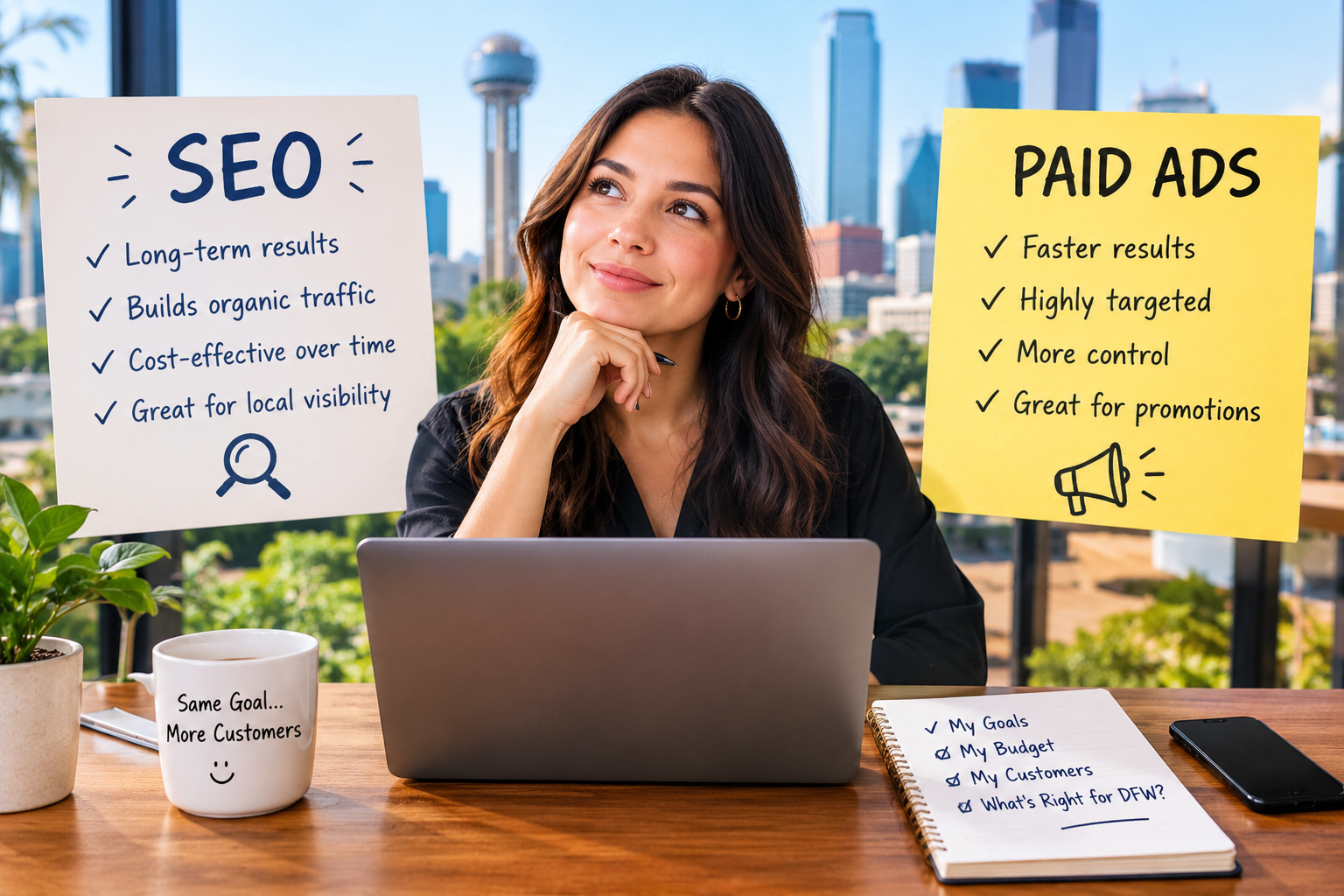
The answer depends on your goals, budget, competition, and how quickly you need results. SEO can help build long-term visibility in organic search, while paid advertising can provide more immediate exposure when campaigns are set up effectively.
In this guide, we will compare SEO vs paid advertising for small businesses in DFW, explain how to evaluate their costs, and show you how to decide where to invest first.
What Is the Difference Between SEO and Paid Advertising?
Before deciding where to invest your money, it helps to understand what you are paying for.
What Is SEO?
Search engine optimization, commonly called SEO, involves improving your website and online presence so that search engines can understand your business and show relevant pages to people searching for your services.
For example, imagine you run a plumbing company in Fort Worth. A potential customer searches for information about a leaking pipe or looks for a local plumber. SEO can help your website become more relevant and visible for searches related to your services.
SEO activities may include:
- Improving website content and service pages.
- Researching relevant keywords and search intent.
- Fixing technical website issues.
- Improving internal links and website navigation.
- Optimising your Google Business Profile (GBP), also known as Google My Business (GMB), for eligible local businesses.
- Earning relevant, trustworthy backlinks.
- Publishing helpful content that answers customers’ questions.
The goal is to make it easier for potential customers to discover your business organically, without paying Google for each click on an organic result.
However, SEO requires work, and results are not immediate or guaranteed. Your progress depends on factors such as your website’s current condition, competition, the quality of your work, and how well your pages meet searchers’ needs.
What Is Paid Advertising?
Paid advertising allows your business to pay for exposure on advertising platforms.
One common example is Google Ads, where businesses can bid to show advertisements to people searching for relevant products or services. Depending on the campaign, you may pay per click, impression, or another defined advertising action.
Suppose you operate an air conditioning repair company in Arlington during the summer. You want to reach people searching for repair services now rather than wait for your website to gain organic visibility.
A carefully targeted Google Ads campaign may help you reach those searchers sooner.
Paid advertising can also include social media advertising and other online promotional campaigns, but this article focuses primarily on search advertising because it is particularly relevant to people actively looking for local services.
Google explains the differences between organic search and paid search in its guide to SEO vs. PPC.
The important distinction is that SEO aims to earn organic visibility, while paid advertising purchases exposure through an advertising platform.
SEO vs Paid Advertising: A Side-by-Side Comparison
Both approaches can support business growth, but they operate differently.
| Factor | SEO | Paid advertising |
| Speed | Usually takes time to build visibility | Ads can begin appearing after approval and launch |
| Cost | May include agency fees, content, development, and ongoing work | Includes advertising spend and potentially campaign management fees |
| Traffic | Can continue attracting visitors while pages remain visible | Traffic from ads generally depends on campaigns continuing to run |
| Targeting | Visibility depends on relevance, search intent, and ranking factors | Campaigns can target selected keywords, locations, and other eligible criteria |
| Long-term value | Can build lasting website visibility and useful content assets | Can provide flexible exposure while funding is available |
| Measurement | Search visibility, organic traffic, enquiries, and sales | Impressions, clicks, costs, conversions, and sales |
| Main challenge | Results may take time and require sustained effort | Poor targeting or campaign management can waste budget |
Neither option automatically produces better results. What matters is whether the approach matches your business objectives and generates worthwhile enquiries.
When Does SEO Make More Sense for a Small Business in DFW?
SEO deserves consideration if you want to build your online presence over time rather than depend entirely on advertising.
1. You Want Customers to Find You Without Paying for Every Click
Imagine someone searching for a service you offer in Dallas. If one of your relevant website pages appears in organic results, that visitor can click through without you paying Google for that individual organic click.
That does not mean SEO is free. You may invest in content creation, website improvements, technical work, and professional support. The difference is that organic clicks do not incur the same direct per-click advertising charge.
Over time, useful pages may continue attracting relevant visitors, although rankings and traffic can fluctuate.
2. You Want to Build Local Visibility
For businesses serving specific communities, local SEO can help connect your services with relevant searches.
A home improvement company in Fort Worth, a med spa in Plano, or a professional services firm in Dallas may need to improve its website, local business information, and service content to reach potential customers.
Your Google Business Profile can also support local discovery, particularly in Google Maps and local search results.
However, creating a profile or adding a city name to your website does not guarantee rankings. Local visibility depends on several factors, including relevance, distance, and prominence.
You can learn more in our guide to local SEO ranking factors.
3. You Want to Answer Questions Before Customers Contact You
Not everyone who searches online is ready to buy immediately.
Someone considering a home renovation might first research costs, compare providers, or look for signs that a contractor is qualified.
Educational articles, useful service pages, and clear FAQs can help your business answer those questions.
For example, an accounting firm in Dallas could publish helpful information about preparing for tax season. A roofing company in Arlington might explain what homeowners should consider when evaluating roof repair options.
Useful content can help people understand your services before they contact you. It can also create opportunities for organic search visibility over time.
4. You Want to Reduce Dependence on a Single Marketing Channel
If every new customer comes from paid advertising, what happens when your advertising budget is reduced?
Building organic visibility alongside advertising can give your business another way to attract potential customers. SEO is not a guarantee of free leads, but it can diversify your sources of online discovery.
The key is consistency. Publishing content without a clear purpose, ignoring website problems, or expecting immediate rankings can make SEO frustrating.
When Is Paid Advertising the Better Starting Point?
Although SEO can build long-term visibility, some business situations call for a faster approach.
1. You Need to Promote a Service or Offer Now
Suppose your business has introduced a new service or is promoting a limited-time offer. You may not have months to wait for a new page to gain organic visibility.
Paid search advertising can help you reach relevant searchers while the offer is available.
You can adjust campaign settings, messaging, and budgets as you learn which approaches generate useful responses.
2. Your Website Is New
A newly launched website may have little search visibility, limited content, and few established signals of authority.
Paid advertising can help introduce the business to potential customers while you improve the website and develop your organic strategy.
However, sending paid traffic to a confusing website is rarely a good use of money. Before launching a campaign, make sure visitors can understand what you offer, find relevant information, and contact you easily.
3. You Want to Test Customer Demand
Paid campaigns can help you test whether people respond to particular service offerings, messages, or search terms.
For example, a Dallas business might want to compare demand for two related services. A properly structured campaign can provide information about clicks, enquiries, and conversion rates.
But remember that clicks alone do not prove demand is profitable. You need to know whether the people contacting you are suitable prospects and whether the resulting sales justify the cost.
4. You Can Measure and Manage Your Advertising Spend
Google Ads allows advertisers to set budgets and select bidding strategies. Your actual results will depend on competition, campaign settings, ad relevance, landing-page quality, and other factors.
Before launching, decide how much you can reasonably spend, what counts as a valuable enquiry, and how you will measure outcomes.
Google provides guidance on choosing your advertising budget and bids.
Do not assume that a larger advertising budget automatically means more profitable customers.
SEO vs Paid Advertising: Which Costs Less?
This is where many business owners need to look beyond the headline price.
SEO may involve monthly professional fees, check here for price guidance, check website development, content production, technical improvements, and time spent managing the work. It can take time to generate meaningful results, particularly in competitive markets.
Paid advertising has its own expenses. You may pay for clicks, campaign management, landing-page improvements, conversion tracking, and creative work.
The total cost depends on your industry, target keywords, location, competition, and the quality of your marketing setup.
For example, two businesses in DFW may advertise similar services but experience different costs because their target audiences, competition, and conversion rates differ.
Rather than asking only which service costs less, consider the cost of generating a qualified lead and acquiring a customer.
Imagine your business spends $1,000 on a marketing campaign. If it generates enquiries but none turn into customers, the campaign needs investigation. If another campaign costs more but consistently attracts profitable customers, the higher expense may be justified.
These are illustrative examples, not expected performance benchmarks. Your actual results will depend on your business and market.
Track metrics such as:
- Marketing spend.
- Qualified enquiries.
- Cost per qualified lead.
- Number of new customers.
- Revenue generated.
- Profit after relevant acquisition costs.
This gives you a more useful basis for deciding where your money should go.
How to Compare Cost Per Lead and Customer Acquisition
If you want to know whether SEO or paid advertising offers better value, look beyond traffic and rankings.
Two measurements can help.
Cost per lead is the amount spent to generate a lead. For a simple calculation, divide the relevant marketing cost by the number of leads generated.
Customer acquisition cost measures the cost of acquiring actual customers. It should account for the relevant sales and marketing expenses included in your calculation, not merely the cost of a website visit.
For example, imagine an advertising campaign costs $800 and generates 20 enquiries.
The cost per enquiry is $40.
But suppose only four of those enquiries become customers. The advertising cost per acquired customer is then $200, before any additional costs you choose to include.
These figures are hypothetical, but they demonstrate why the number of enquiries alone does not tell the full story.
Apply the same principle to SEO. Consider the cost of the work over a defined period, the qualified leads it generates, and how many of those leads become customers.
Be fair when comparing the channels. SEO costs may support pages that attract visitors over an extended period, whereas advertising spend is often tied to a specific campaign period. Use consistent measurement periods and account for the work each channel requires.
Should You Use SEO and Paid Advertising Together?
For some businesses, combining the two is a sensible approach. The important thing is to give each channel a clear purpose.
A DFW business might use paid advertising to test demand for a service while investing in SEO to improve its organic visibility over time.
For example:
- Paid advertising: Test whether relevant search terms generate qualified enquiries at an acceptable cost.
- SEO: Develop the organic visibility of important service pages and useful supporting content.
- Shared learning: Use information from enquiries and sales to understand which services customers value.
- Performance measurement: Review the cost and business outcomes of each channel separately.
Do not assume that an advertising campaign will automatically improve your organic rankings. Google states that advertising does not influence a website’s presence in organic search results.
Also, do not split your budget between the two channels just because using both sounds like a complete marketing strategy. If your resources are limited, prioritise the activity that best addresses your current business need.
A Practical Decision Guide for DFW Business Owners
Use the following guide to decide where to begin.
Prioritise paid advertising if:
- You need to promote a ready-to-sell service quickly.
- You can fund a defined campaign and test its performance.
- You can measure qualified leads and customer conversions.
- Your website is prepared to handle the traffic and enquiries.
Prioritise SEO if:
- You can invest in organic visibility over a longer period.
- You want to reduce dependence on paid traffic.
- Your business has useful services and information to make discoverable.
- You can fund ongoing improvements without expecting immediate returns.
Consider both if:
- You have enough budget to support both activities properly.
- You can measure their results separately.
- Your immediate and longer-term goals require different approaches.
You do not need to make a permanent decision. Review your results, learn from customer behaviour, and adjust your investment when the evidence supports a change. One important point: paying for Google Ads does not improve your organic Google rankings. confirms this in our 10 Questions to Ask Before Hiring a Local SEO Agency in Dallas. You can use advertising data to inform your content and marketing decisions, but paid placement does not buy organic ranking positions. If your budget is limited, do not feel pressured to fund both channels immediately. Start with the approach that best addresses your most urgent business need, then expand when you have evidence that additional investment makes sense.
Need Help Choosing the Right Marketing Strategy for Your DFW Business?
You do not have to spend money on every marketing channel to grow your business. You need to understand where your customers are looking, what prevents them from finding you, and which improvements are most relevant to your goals.
Local SEO GMB Marketing helps businesses across Dallas, Fort Worth, Arlington, Plano, Irving, Frisco, McKinney, Richardson, and surrounding DFW communities improve their online visibility through local SEO, Google Business Profile (GBP, formerly GMB) optimization, keyword research, and website SEO.
If your business is not getting enough enquiries from Google, it may be worth reviewing your current visibility before increasing your advertising budget.
Visit Local SEO GMB Marketing to explore our services, or request a free Google Business Profile audit to identify potential issues with your local business presence.
Whether you are considering SEO, paid advertising, or a combination of both, the aim is to make informed decisions that support your business rather than spend money without a clear direction.
Start by understanding your current position. Then invest in the strategy that best fits your goals, customers, and budget.
Frequently Asked Questions About SEO vs Paid Advertising
1. Is SEO better than paid advertising for small businesses?
Neither is universally better. SEO can support long-term organic visibility, while paid advertising can provide faster exposure for specific services and offers. The right choice depends on your goals, budget, competition, and how quickly you need results.
2. How long does SEO take to work compared with Google Ads?
Paid ads may begin appearing after a campaign is approved and launched, although profitable results are not guaranteed. SEO typically takes longer because search engines need to discover, evaluate, and rank your pages. The timeline varies depending on competition, website condition, and the work involved.
3. Is SEO cheaper than Google Ads?
SEO avoids direct per-click charges for organic traffic, but professional SEO still costs money and requires ongoing effort. Google Ads involves advertising spend and may also require management fees. Compare the total investment with qualified leads, customers, and revenue rather than comparing one fee alone.
4. Can I run Google Ads while doing SEO?
Yes. Many businesses use both to support different goals. Paid campaigns can help promote services and test demand, while SEO improves the website’s organic visibility over time. Track each channel separately and ensure your combined marketing costs are sustainable.
5. What is the best marketing strategy for a small business in Dallas–Fort Worth?
Start with your business goals, available budget, and current online visibility. Make sure your website and business information are accurate, improve your ability to measure enquiries, and choose the channel that addresses your biggest need. A local business may benefit from local SEO, paid search advertising, or both, depending on its circumstances.